
Salesforce Certified Tableau Next Consultant practice exam

Try 5 Tableau Next Consultant practice questions with the answer, a plain-language explanation, and a link to the official source for each one.

Try the sample questionsJoin the beta free

Free during the beta: practice this exam and 20 others for 60 days.

The real exam: 60 questions, 105 minutes, 65% to pass. Official exam guide

Try 5 sample questions

One question from each of the most heavily weighted topics. Pick an answer and check it, the way you would inside TrailScout.

  1. Question 1 of 5

    Agentic Experiences

    A sales semantic model serves two different agents built for conversational analytics. The analytics team has 150 frequently asked questions with accurate answers and wants to mark all of them as Verified in Q&A Calibration for that model. How many of the 150 can be verified for the model?

    Show the answer and explanation

    Correct answer: D. Only 100, because one cap covers the model, whatever number of agents use it

    The number of verified questions is limited to 100 per semantic model, and verified questions are saved in a repository with the related semantic model, so this model can hold at most 100 no matter how many agents use it. The most tempting mistake is counting the limit per agent, which would wrongly suggest that two agents make room for all 150.

    Read from the source: Use Q&A Calibration to Improve Accuracy in Tableau Agent (Beta)
  2. Question 2 of 5

    Data Setup

    A corporate analytics team owns a Sales base semantic model, and a regional team built an extended model on it that adds a Regional Margin calculated field of its own. A month later, corporate adds a Discount Tier field to the base model, which must stay the single source of truth. What is the result?

    Show the answer and explanation

    Correct answer: D. Discount Tier appears in the regional model, and Regional Margin stays out of the base model

    When you create an extended model, it stays connected to the base model, and the base model remains the single source of truth. Changes to the base flow into the extended model automatically, while changes made in the extended model aren't pushed back to the base. Two-way sync is the tempting answer because the models stay linked, but the regional calculated field never travels back into corporate's base model.

    Read from the source: Create a Semantic Model in Data 360
  3. Question 3 of 5

    Embedding, Cross-Cloud, & Interoperability

    A developer clicked Copy Embed Code on a Tableau Next dashboard and pasted the snippet, exactly as copied, into a test page of the company's web app. The External Client App (ECA) is set up and the Tableau Next Embedding SDK is installed, but nothing renders. What should the developer do next?

    Show the answer and explanation

    Correct answer: C. Fill in the AUTH_CREDENTIAL and SDK_SOURCE placeholders with actual values

    The snippet from Copy Embed Code contains placeholders for the AUTH_CREDENTIAL and SDK_SOURCE values, and these must be replaced with actual values after the code is copied into the web app. With the ECA and the Embedding SDK already in place, the unfilled placeholders explain why nothing renders. Copying the code again is the tempting retry, but a fresh copy contains the same placeholders.

    Read from the source: Copy Tableau Next Component Code for Embedding
  4. Question 4 of 5

    Visualizations & Dashboards

    While adding a parameter widget to a budget dashboard, the author finds no growth-rate parameter in the list, although the underlying data includes a Growth Rate field. Budget analysts need the widget to switch growth rates so they can explore different scenarios. What should the author do first?

    Show the answer and explanation

    Correct answer: D. Define a growth-rate parameter in the dashboard's semantic model

    When adding a parameter widget, the author selects a listed parameter from a semantic model, so if no growth-rate parameter is listed, it has to be defined in the semantic model first. Pointing the widget at the Growth Rate field is the tempting shortcut because filter widgets are set up by selecting a listed field, but parameter widgets use parameters, not fields.

    Read from the source: Create Interactive Dashboards with Parameters
  5. Question 5 of 5

    Basic Setup & Admin

    Data Q&A Indexing and Semantic Enrichments is enabled in Data 360 for the Home org, and the admin has switched on the Analytics Agent setting in Tableau Next. She then created an agent from the Analytics and Visualization V2 template, but Data Analysis isn't listed under Subagents. What should she do?

    Show the answer and explanation

    Correct answer: C. Turn on the Data Analysis setting in Tableau Next Features

    The Analytics Agent setting (Tableau Agent in current Salesforce Help) enables the Analytics and Visualization template, while turning on Data Analysis enables the Data Analysis subagent, and the V2 template requires both settings plus Data Q&A Indexing and Semantic Enrichments in Data 360. Since indexing and the agent setting are already on, the missing Data Analysis setting is the cause. The most tempting wrong choice adds the subagent after activation, but the setup steps confirm Data Analysis under Subagents while building the agent, before activating it.

    Read from the source: Set Up Tableau Agent in Tableau Next

175 more questions are waiting.

The full Tableau Next Consultant practice exam has 180 questions, study sessions, full-length exam simulations, and a Detour Deck that collects the questions you miss.

One free beta pass covers this exam and 20 others for 60 days.

Join the beta free today

Practice, review, and know what to study next.

  1. 1

    Answer first

    Choose an answer, then compare it with the explanation and official source.

  2. 2

    Read from the source

    Every explanation links to the official documentation it is based on.

  3. 3

    Focus where you missed

    Your results show accuracy by topic, and missed questions go to your Detour Deck.

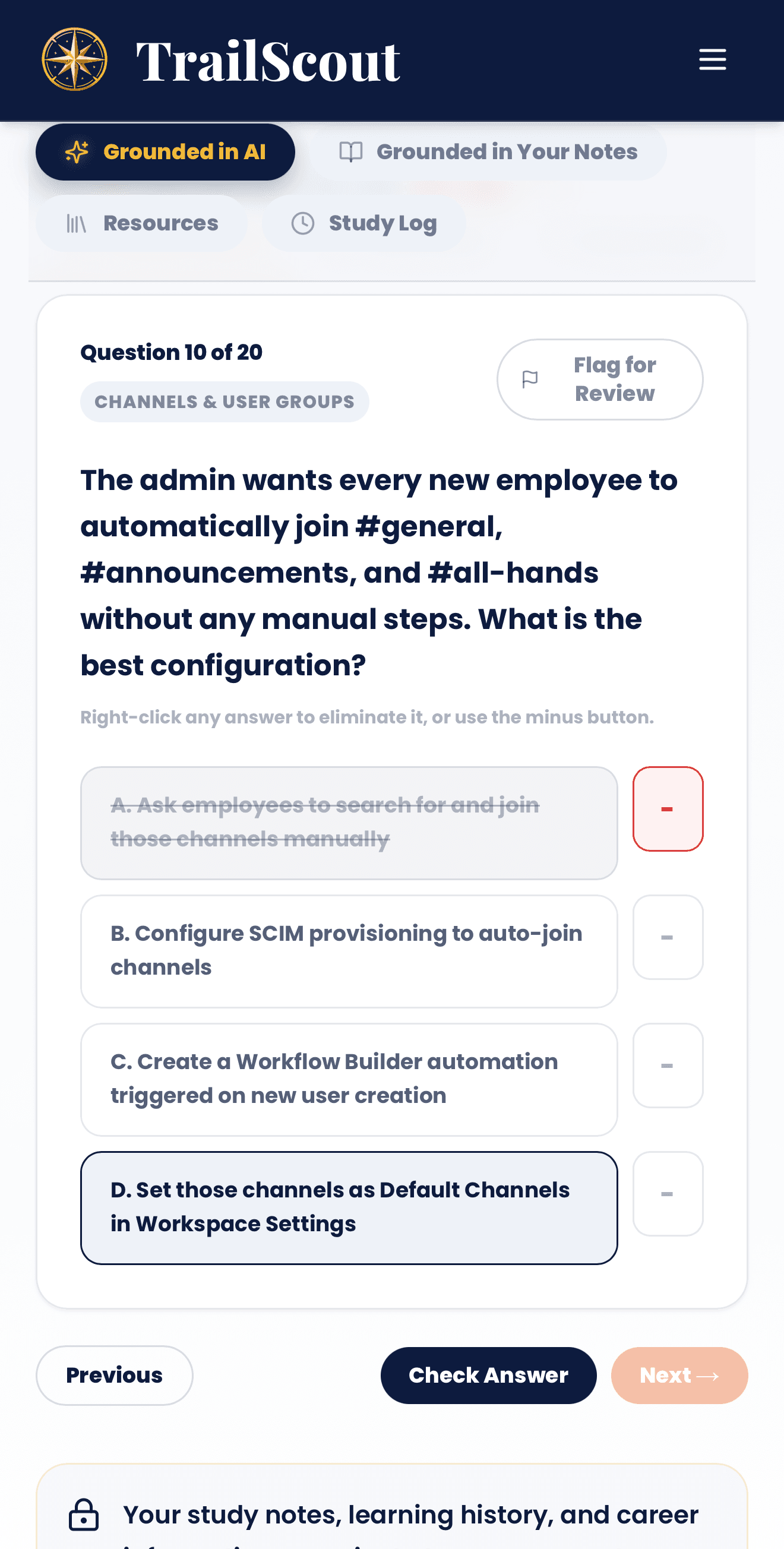
TrailScout practice question with one answer ruled out
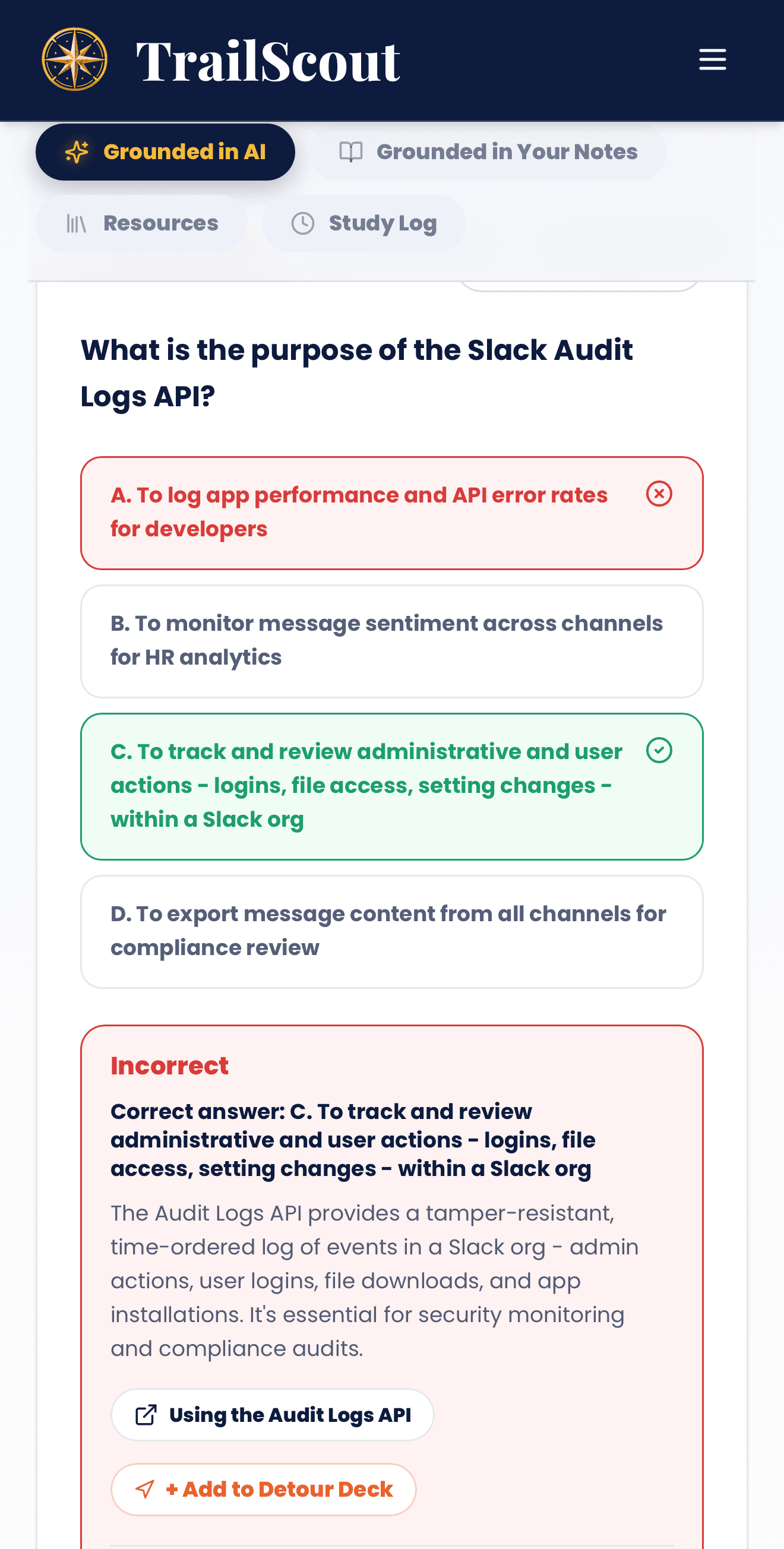
TrailScout explanation card with the official source and a Detour Deck button
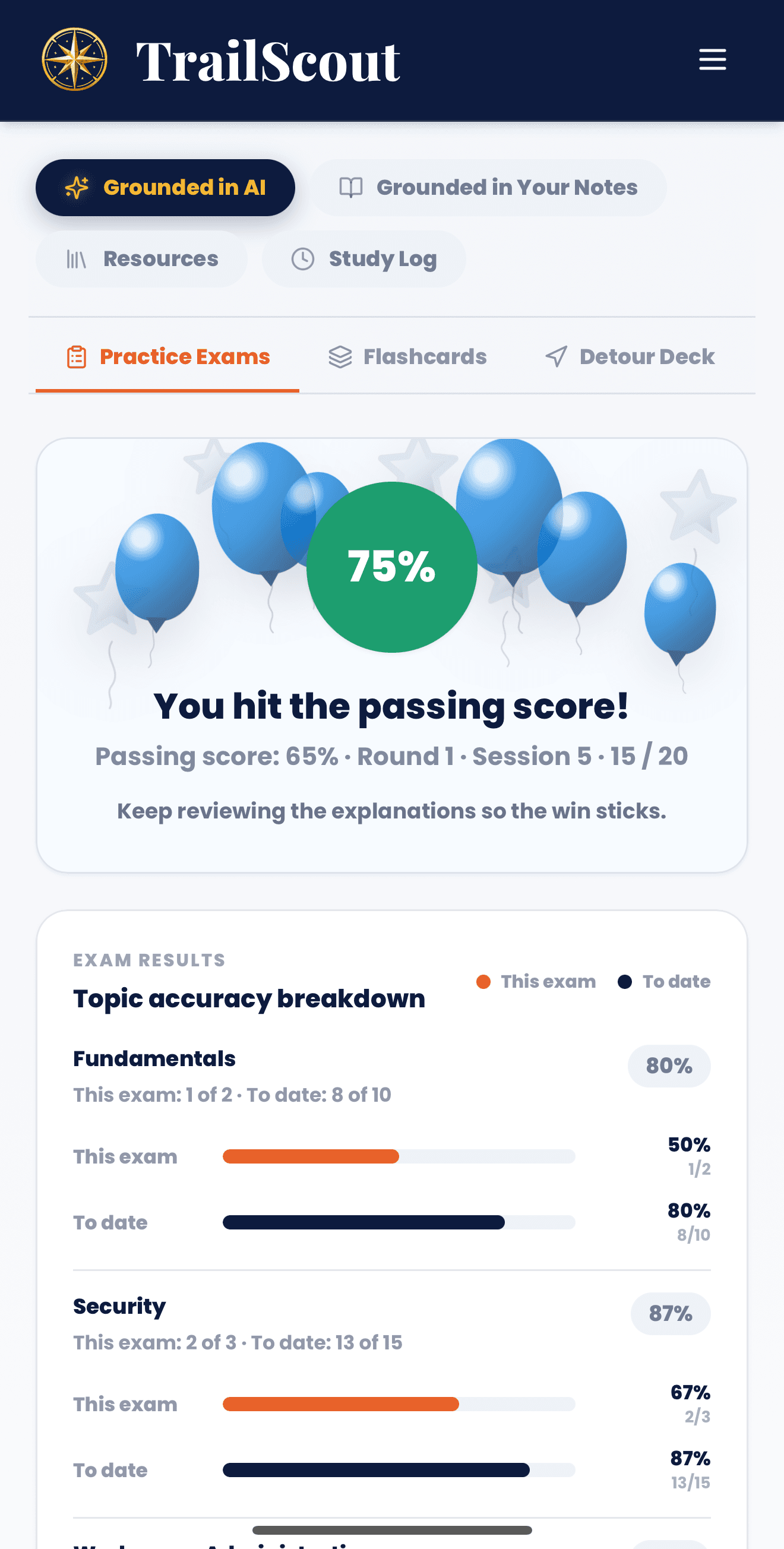
TrailScout session result showing 75 percent and accuracy by topic
1. AnswerRule out choices, then pick your answer.2. ReviewRead why, with the official source one tap away.3. FocusSee your score by topic and what to study next.

Example screens from the Slack Administrator practice exam.

Tableau Next Consultant exam topics

Topic weights from the official exam guide. TrailScout practice follows the same weights.

  • Agentic Experiences25%
  • Data Setup20%
  • Embedding, Cross-Cloud, & Interoperability20%
  • Visualizations & Dashboards15%
  • Basic Setup & Admin10%
  • Managing Workspaces & Orgs10%

About the Tableau Next Consultant exam

How many questions are on the Salesforce Certified Tableau Next Consultant exam?
The official exam guide lists 60 multiple-choice questions, and you have 105 minutes to finish.
What score do you need to pass the Tableau Next Consultant exam?
The official exam guide sets the passing score at 65%.
Are these real exam questions?
No. TrailScout writes original practice questions from the official exam guide and official product documentation, and every explanation links to the official page it is based on. They are built to practice the way the exam asks, not to copy it.
What is in the full TrailScout Tableau Next Consultant practice exam?
180 practice questions across the topics in the exam guide, study sessions and full-length exam simulations, an explanation for every choice, source links, and a Detour Deck for the questions you miss.

Ready for the full Tableau Next Consultant practice exam?

Join free during the beta to save your progress, see your score by topic, and keep practicing until exam day.

Join the beta free today

Studying for something else? See every exam TrailScout supports

Salesforce Tableau Next Consultant Practice Exam: Free Sample Questions | TrailScout