

Salesforce Certified Revenue Management Consultant practice exam

Try 5 Revenue Management Consultant practice questions with the answer, a plain-language explanation, and a link to the official source for each one.

Try the sample questionsJoin the beta free

Free during the beta: practice this exam and 20 others for 60 days.

The real exam: 60 questions, 105 minutes, 63% to pass. Official exam guide

Try 5 sample questions

One question from each of the most heavily weighted topics. Pick an answer and check it, the way you would inside TrailScout.

  1. Question 1 of 5

    Agentforce Revenue Management Platform Concepts

    A flow builder who has Manage Flow and Rule Engine Runtime created the org's first decision matrix, a table of shipping surcharges, and saved it yesterday. Nothing else has been done to the matrix since then. Today, the flow's New Action window shows no Decision Matrices category. What should the builder do?

    Show the answer and explanation

    Correct answer: A. Activate a version of the decision matrix

    The Decision Matrices category appears in the New Action window only when the org has a decision matrix with at least one active version, and this org's only matrix has been saved but not activated. Assigning Rule Engine Designer is tempting because missing options often mean missing permissions, but the builder already has Manage Flow to create the flow and Rule Engine Runtime to invoke a decision matrix.

    Read from the source: Invoke a Decision Matrix in a Flow
  2. Question 2 of 5

    Configure, Price, Quote

    A manufacturer built two custom configurator flows, one for networking bundles and one for storage bundles, each with its own option screens. Reps must see the networking flow only when configuring networking bundles and the storage flow only when configuring storage bundles. What should the admin do?

    Show the answer and explanation

    Correct answer: D. Associate each flow template with the products or product classes of its product line

    Flow template association ties a flow template to products or product classes so it renders for them at run time, which lets each product line get its own flow. The Default Product Configurator Flow is the predefined flow used as a template to create customized flows, not the setting that decides which flow renders for which products. Visibility rule outcomes only make visual updates, such as hide, disable, or exclude, to the configured product.

    Read from the source: Product Configurator Essentials
  3. Question 3 of 5

    Asset Management

    An asset's prior sale transactions include 10 licenses at $100 each from January and 10 more at $120 each from June. An amendment is being priced with an accepted negative delta quantity of -4 licenses, and the current list price is $130. What reduction amount results?

    Show the answer and explanation

    Correct answer: A. $480, at the June price of $120 each

    When an amendment contains a negative delta quantity, the system calculates the total price from prior asset sale prices by using a Last In First Out strategy across multiple prior transactions. The June licenses were sold last, so the 4 licenses come off at $120 each, a $480 reduction. The January price is the most tempting wrong answer, but Last In First Out takes the most recent sale price first, not the oldest.

    Read from the source: Amend Assets with the Managed Asset Viewer
  4. Question 4 of 5

    Catalog Management

    Each storage server in a configurable bundle ships with two drive sleds, so the sled component's quantity is 2. Reps often quote several servers on one line, and the cart must hold two sleds for every server quoted. Which Quantity Scaling Method setup should the designer use on the sled component?

    Show the answer and explanation

    Correct answer: A. Proportional, with Allow Quantity Changes deselected

    Proportional changes the child quantity in proportion to the parent quantity, and it is the default when Allow Quantity Changes isn't selected, so two sleds per server scale with every server quoted. Constant is the closest trap because the count per server is fixed, but Constant holds the cart at the design-time quantity whatever the parent quantity is.

    Read from the source: Product Relationship Management in Revenue Cloud
  5. Question 5 of 5

    Implementation Readiness

    A company already invoices customers through Revenue Cloud with only the Billing license. It now wants reps to configure product bundles and price quotes in Revenue Cloud, and it doesn't need Salesforce Contracts or order orchestration. What does the company need first?

    Show the answer and explanation

    Correct answer: D. A Revenue Cloud Growth or Revenue Cloud Advanced license

    A Revenue Cloud license determines the functional areas an org gets, and Salesforce Pricing, Product Configurator and Transaction Management are available with Growth and Advanced but not with Billing. Because the company doesn't need Salesforce Contracts or Dynamic Revenue Orchestrator, Growth or Advanced meets the need. Product Catalog Management is the most tempting answer because it is already available with the Billing license, but configuring and pricing quotes need functional areas that Billing doesn't include.

    Read from the source: Revenue Cloud License Comparison

175 more questions are waiting.

The full Revenue Management Consultant practice exam has 180 questions, study sessions, full-length exam simulations, and a Detour Deck that collects the questions you miss.

One free beta pass covers this exam and 20 others for 60 days.

Join the beta free today

Practice, review, and know what to study next.

  1. 1

    Answer first

    Choose an answer, then compare it with the explanation and official source.

  2. 2

    Read from the source

    Every explanation links to the official documentation it is based on.

  3. 3

    Focus where you missed

    Your results show accuracy by topic, and missed questions go to your Detour Deck.

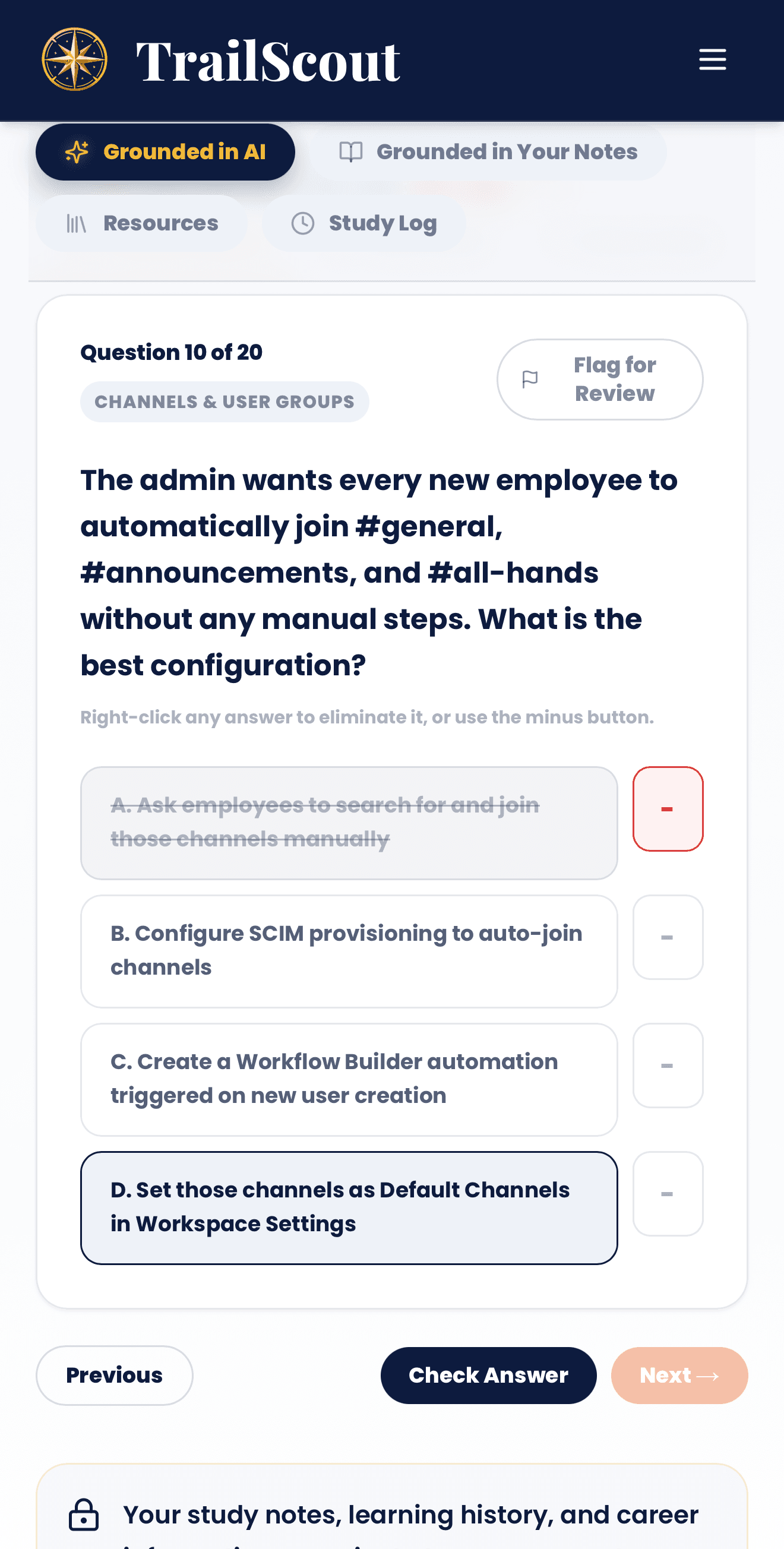
TrailScout practice question with one answer ruled out
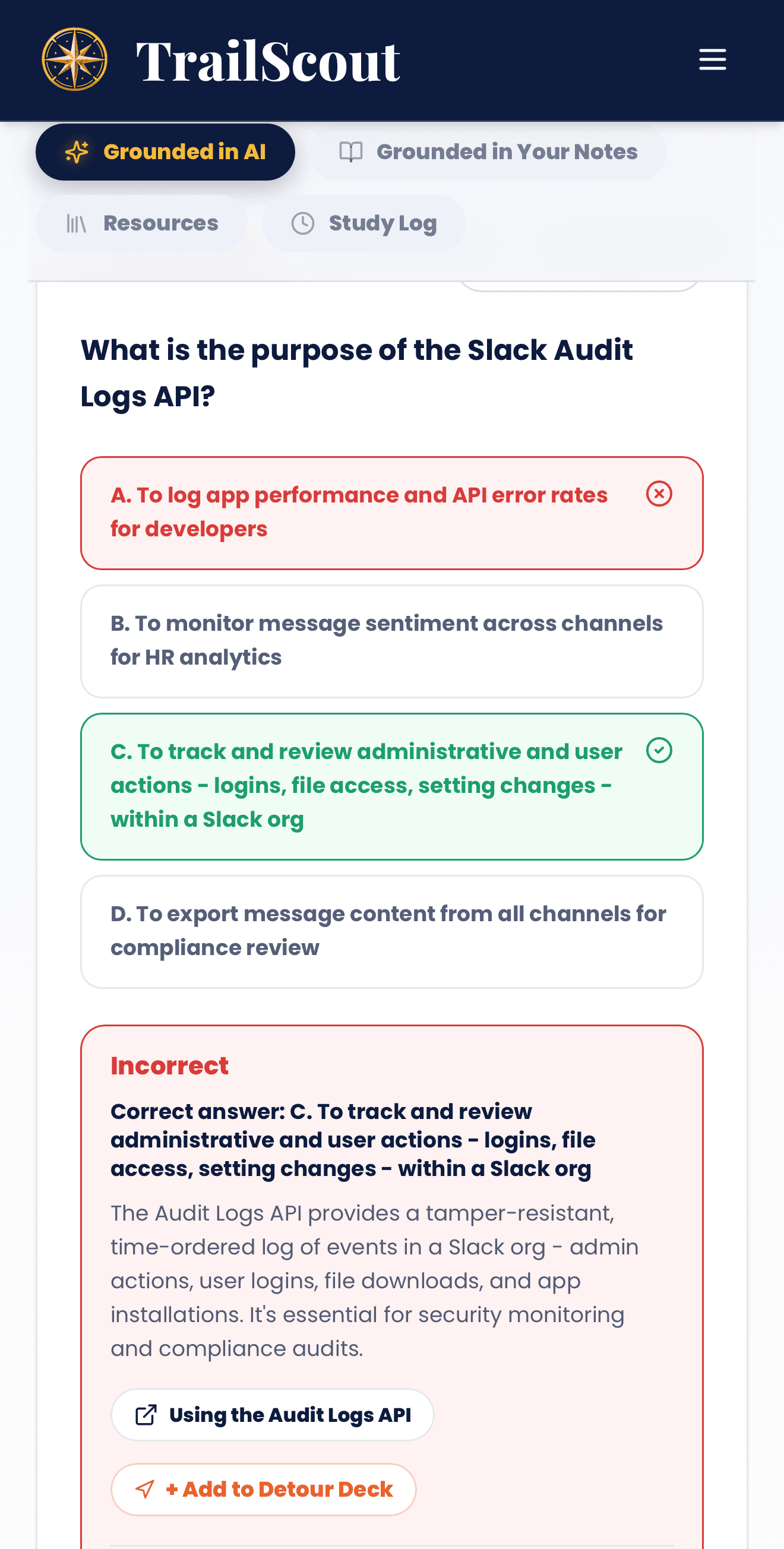
TrailScout explanation card with the official source and a Detour Deck button
TrailScout session result showing 75 percent and accuracy by topic
1. AnswerRule out choices, then pick your answer.2. ReviewRead why, with the official source one tap away.3. FocusSee your score by topic and what to study next.

Example screens from the Slack Administrator practice exam.

Revenue Management Consultant exam topics

Topic weights from the official exam guide. TrailScout practice follows the same weights.

  • Agentforce Revenue Management Platform Concepts18%
  • Configure, Price, Quote18%
  • Catalog Management16%
  • Asset Management16%
  • Implementation Readiness14%
  • Contracts and Orders11%
  • Invoice Management7%

About the Revenue Management Consultant exam

How many questions are on the Salesforce Certified Revenue Management Consultant exam?
The official exam guide lists 60 multiple-choice questions, and you have 105 minutes to finish.
What score do you need to pass the Revenue Management Consultant exam?
The official exam guide sets the passing score at 63%.
Are these real exam questions?
No. TrailScout writes original practice questions from the official exam guide and official product documentation, and every explanation links to the official page it is based on. They are built to practice the way the exam asks, not to copy it.
What is in the full TrailScout Revenue Management Consultant practice exam?
180 practice questions across the topics in the exam guide, study sessions and full-length exam simulations, an explanation for every choice, source links, and a Detour Deck for the questions you miss.

Ready for the full Revenue Management Consultant practice exam?

Join free during the beta to save your progress, see your score by topic, and keep practicing until exam day.

Join the beta free today

Studying for something else? See every exam TrailScout supports

Salesforce Revenue Management Consultant Practice Exam: Free Sample Questions | TrailScout