
Salesforce Certified Platform Integration Architect practice exam

Try 5 Platform Integration Architect practice questions with the answer, a plain-language explanation, and a link to the official source for each one.

Try the sample questionsJoin the beta free

Free during the beta: practice this exam and 20 others for 60 days.

The real exam: 60 questions, 105 minutes, 67% to pass. Official exam guide

Try 5 sample questions

One question from each of the most heavily weighted topics. Pick an answer and check it, the way you would inside TrailScout.

  1. Question 1 of 5

    Design Integration Solutions

    When a rep marks an opportunity Closed Won, a fulfillment platform must start a provisioning process that runs for several hours. The rep must not be kept waiting, nothing in Salesforce depends on the provisioning result, and the admin team prefers declarative configuration over custom Apex. Which approach should the architect choose?

    Show the answer and explanation

    Correct answer: D. Fire and Forget, with a record-triggered flow that publishes a platform event

    Salesforce starting a remote process without waiting for it to finish is Remote Process Invocation (Fire and Forget), and flow-driven platform events are its best-fit solution when the remote process is invoked from an insert or update event. The pattern also prefers platform events over Apex callouts when declarative configuration is preferred. The tempting alternative is an Apex trigger that makes an asynchronous callout, which is rated suboptimal and needs the custom Apex the team wants to avoid.

    Read from the source: Integration Patterns: Remote Process Invocation, Fire and Forget
  2. Question 2 of 5

    Build Solution

    A distribution company's ERP is the source of truth for customer contact details and must push each change to the matching Salesforce contact as it happens. Changes arrive one at a time, each touches only the contact record, and none needs Salesforce-side processing before it is saved. Which approach should the integration use?

    Show the answer and explanation

    Correct answer: A. Have the ERP upsert the contact through SOAP API or PATCH the Contact REST resource

    Native Salesforce APIs cover this case: the ERP can upsert the Contact object through SOAP API or send a PATCH to the Contact sObjects REST API. Custom Apex REST or SOAP web services are for needs beyond the native endpoints, such as cross-object processing or other complex logic, and an Apex web service's benefit must be weighed against the additional code to maintain in Salesforce. An Apex REST service is the tempting choice, but nothing in this single-object update needs what it adds.

    Read from the source: Data Integration with Salesforce
  3. Question 3 of 5

    Translate Needs to Integration Requirements

    At month-end, record-triggered flows in an Enterprise Edition org with no event add-on licenses publish about 300,000 platform events within one hour. The events are used only for messaging inside the org, and Apex triggers in the same org are their only subscribers. Will this burst fit within the org's default event allocations?

    Show the answer and explanation

    Correct answer: D. It will not fit, since 300,000 in one hour tops a 250,000 hourly cap that covers flow publishing

    The event publishing allocation counts messages sent to the event bus per hour by any method, including flows, and Enterprise Edition's default is 250,000 per hour, so 300,000 events in one hour exceed it even though the events never leave the org. The most tempting wrong choice treats trigger-only internal events as free, but only the delivery allocation excludes Apex triggers; publishing always counts. Over the limit, the publish call fails and the events aren't queued.

    Read from the source: Default Platform Event Allocations for Event Publishing and Delivery
  4. Question 4 of 5

    Evaluate Business Needs

    Data subject requests at a company now arrive from several jurisdictions with different response deadlines, and an admin fulfills each one by manually exporting data from Salesforce and two integrated systems. Request volume is rising, and a newly entered market has the shortest deadline, measured in days rather than weeks. What should the architect recommend?

    Show the answer and explanation

    Correct answer: B. Automate request intake, tracking, discovery, and fulfillment, sized to the tightest deadline in the footprint

    Short data-subject-request deadlines can't be met by an ad-hoc manual process, so the guidance is to automate DSR handling, naming Experience Cloud for intake, Service Cloud for case tracking, Privacy Center for discovery, and Flow for fulfillment, and to size the design to the tightest window in the operating footprint. The most tempting wrong choice is hardcoding each jurisdiction's deadline, but these figures differ per framework and are amended on the regulators' schedules.

    Read from the source: Well-Architected Trust: Compliance and Regulatory Adherence
  5. Question 5 of 5

    Evaluate the Current System Landscape

    Field technicians run a command-line diagnostics tool on locked-down rugged handhelds that have a small keypad and cannot run a browser. Each technician must reach Salesforce under their own identity, the tool has no back-end service of its own, and every technician carries a company smartphone. Which OAuth flow should the tool use through its connected app?

    Show the answer and explanation

    Correct answer: B. The OAuth 2.0 device flow

    The device flow is for apps on devices with limited input or display capabilities, and command-line apps can use it too: the user completes authorization in a browser on a device with more advanced input capabilities, such as a mobile device, so each technician signs in as themselves on a smartphone. The most tempting wrong choice is the client credentials flow because it needs no browser, but it runs as one specified integration user, so technicians would not work under their own identities.

    Read from the source: OAuth 2.0 Device Flow for IoT Integration

175 more questions are waiting.

The full Platform Integration Architect practice exam has 180 questions, study sessions, full-length exam simulations, and a Detour Deck that collects the questions you miss.

One free beta pass covers this exam and 20 others for 60 days.

Join the beta free today

Practice, review, and know what to study next.

  1. 1

    Answer first

    Choose an answer, then compare it with the explanation and official source.

  2. 2

    Read from the source

    Every explanation links to the official documentation it is based on.

  3. 3

    Focus where you missed

    Your results show accuracy by topic, and missed questions go to your Detour Deck.

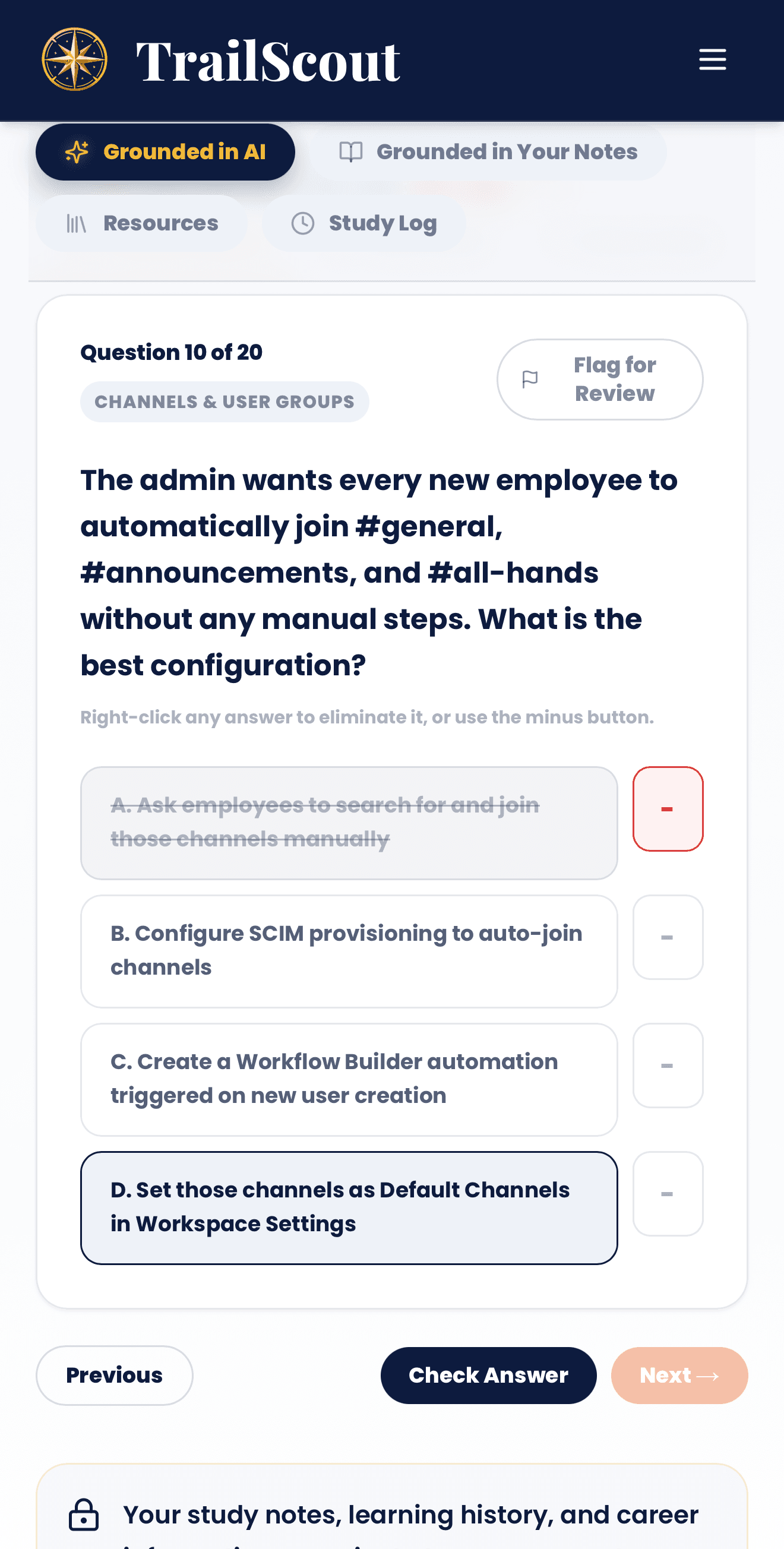
TrailScout practice question with one answer ruled out
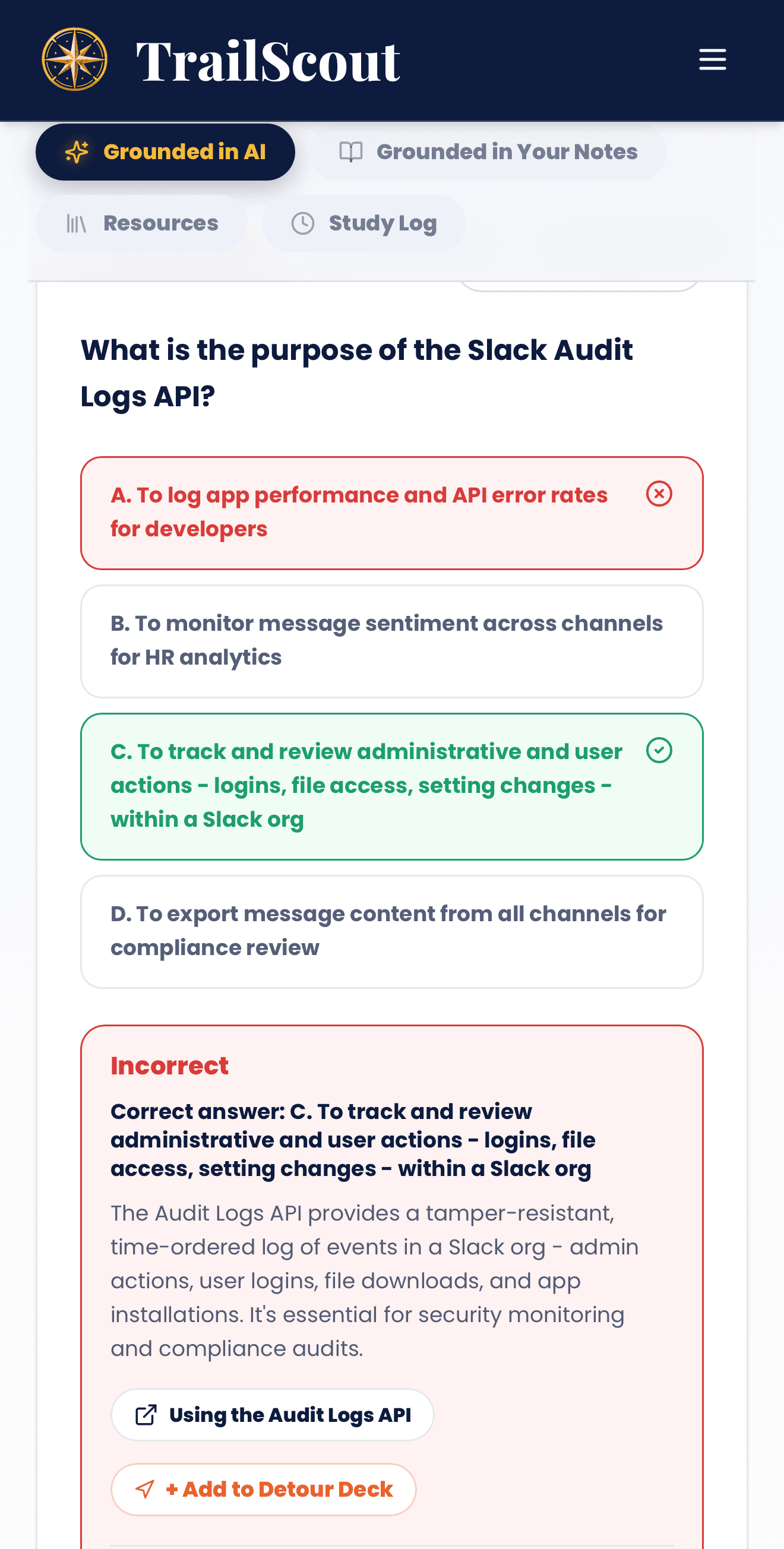
TrailScout explanation card with the official source and a Detour Deck button
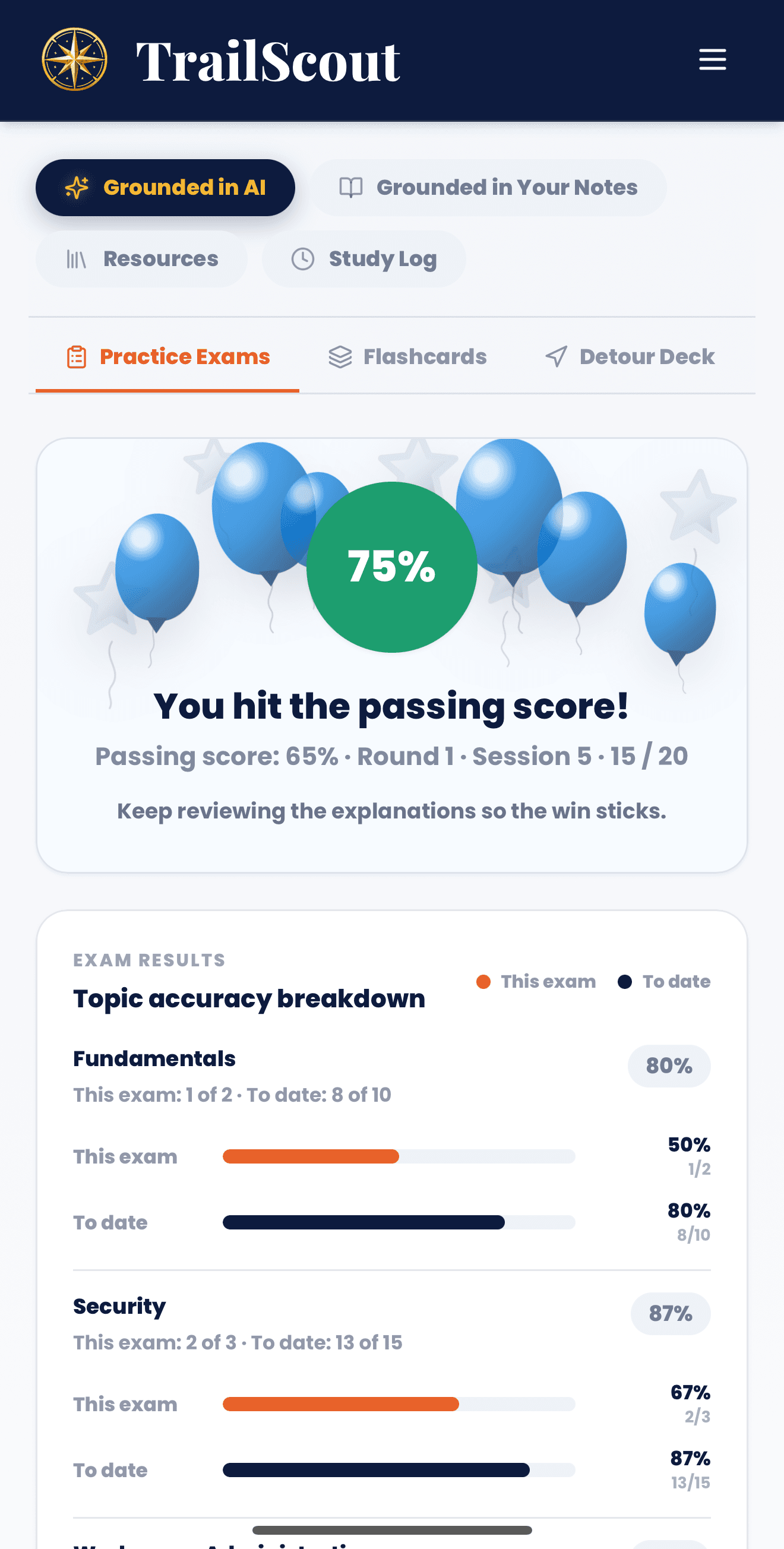
TrailScout session result showing 75 percent and accuracy by topic
1. AnswerRule out choices, then pick your answer.2. ReviewRead why, with the official source one tap away.3. FocusSee your score by topic and what to study next.

Example screens from the Slack Administrator practice exam.

Platform Integration Architect exam topics

Topic weights from the official exam guide. TrailScout practice follows the same weights.

  • Design Integration Solutions28%
  • Build Solution23%
  • Translate Needs to Integration Requirements22%
  • Evaluate Business Needs11%
  • Evaluate the Current System Landscape8%
  • Maintain Integration8%

About the Platform Integration Architect exam

How many questions are on the Salesforce Certified Platform Integration Architect exam?
The official exam guide lists 60 multiple-choice questions, and you have 105 minutes to finish.
What score do you need to pass the Platform Integration Architect exam?
The official exam guide sets the passing score at 67%.
Are these real exam questions?
No. TrailScout writes original practice questions from the official exam guide and official product documentation, and every explanation links to the official page it is based on. They are built to practice the way the exam asks, not to copy it.
What is in the full TrailScout Platform Integration Architect practice exam?
180 practice questions across the topics in the exam guide, study sessions and full-length exam simulations, an explanation for every choice, source links, and a Detour Deck for the questions you miss.

Ready for the full Platform Integration Architect practice exam?

Join free during the beta to save your progress, see your score by topic, and keep practicing until exam day.

Join the beta free today

Studying for something else? See every exam TrailScout supports

Salesforce Platform Integration Architect Practice Exam: Free Sample Questions | TrailScout